Friday, 4 July 2014

The Darker Side of Mostar

The sound of the gurgling river seems to seep through the cobble stones of the narrow alleyways, lined with shops selling Ottoman silks and rugs. Others sell objects slightly more ghastly. Knives. Helmets. Any type of war time memorabilia you can think of, something that is in abundant supply in parts of the Balkans. Minarets penetrate the skyline of the old city which hugs the banks of the river and a huge church tower dominates the western side as sepia roofs give way to modern constructions of glass and concrete. 

High above this a massive cross stands on a hilltop. Mostar is a city of two distinct cultures. Herzegovinans are largely Muslims while the cities Croatian and Serbian residents are Christian. It would be nice to say the two live in complete harmony but they simply don't. They intermingle in their daily lives to an extent but it's clear what the predominant religion is on each side of the river as you move away from the Mosque dominant old town.
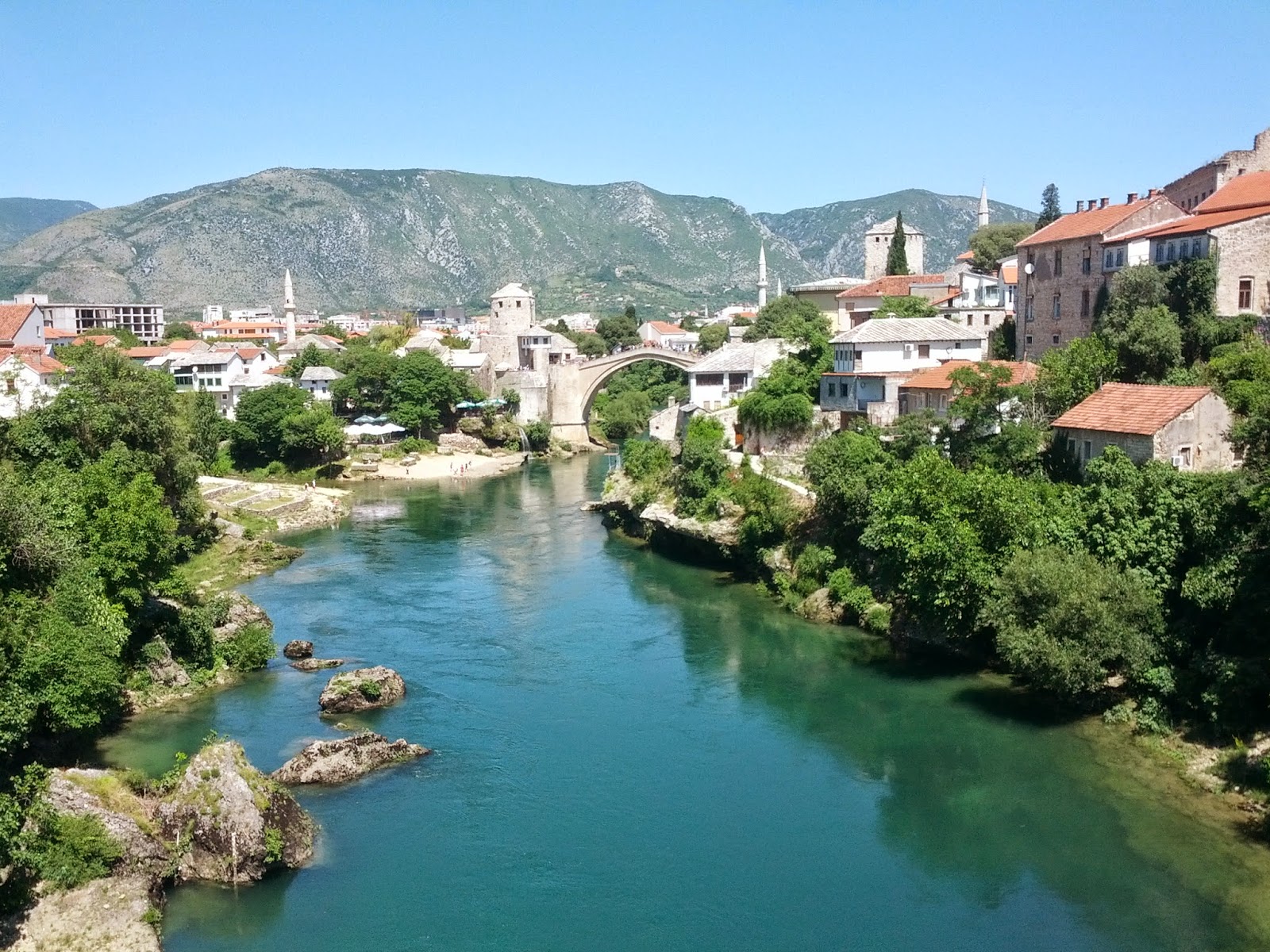
The city lacks any big checklist attractions but everywhere you look the city responds with intriguing tight streets and ornate buildings. An old triangular bridge spans an airy gorge like gap over the river the city surrounds. The city itself sits in a bowl, surrounded by not overly high but quite steep mountains. You can spend ages in the old town, or Stari Grad in the local language, simply taking the place in. But no longer being a well kept secret with an out of the way location it attracts the tourists it deserves. American, British and German accents seep from everywhere and the streets are crowded with outsiders, interspersed with the odd local commuting to and from a mosque. The latter is a small minority when juxtaposed against tourist volume. This quickly makes the old town a tiring place to visit.
* * *

War time sentiments
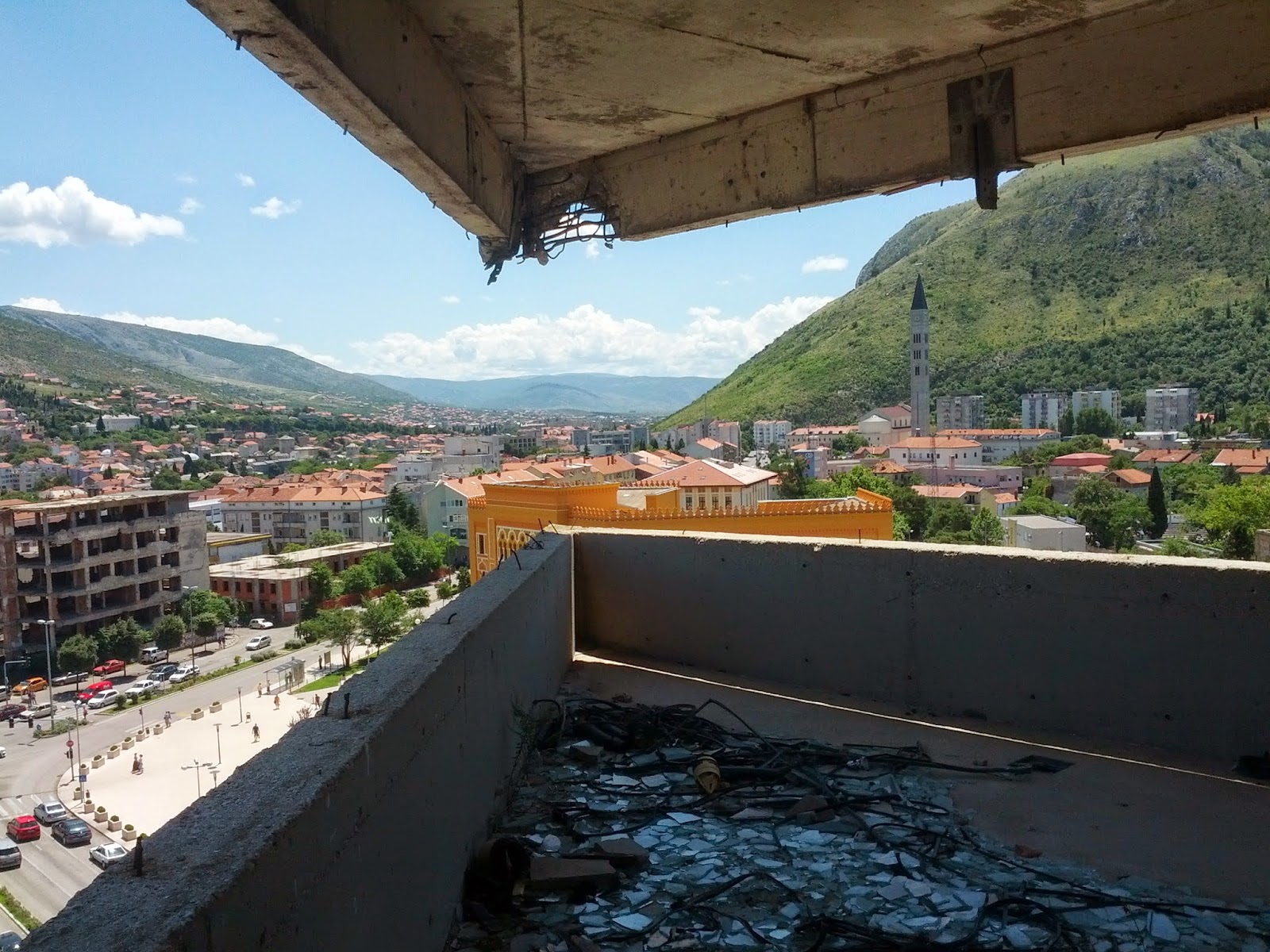
I step up on a block, gripping the top of the concrete barricade and hauling myself into the dark, dingy and graffiti covered space within. My feet crunch as I hit the floor. Rubbish. Lots of rubbish. Everything from plastics, to glass, to household items to the odd bullet casing. I advance forward, cringing as I notice several syringes in close proximity on the ground. The place is obviously frequented by junkies. Good thing we came in the morning. The ground floor bares little resemblance to a inhabited space, only a partitioned room with tile lined walls eluding to its prior function. 

We make our way through a creepy, dark labyrinth of small rooms before realising the stairs weren't in this part of the building. We were glad to escape the dark enclosed space and quickly found the stairs we had spotted from the road. And then I looked up. The stairs double back eighteen times, ascending nine stories, precariously perched on the edge of the building with no kind of protection. This becomes quite an intimidating prospect for those that know these stairs survived and eighteen month siege. 
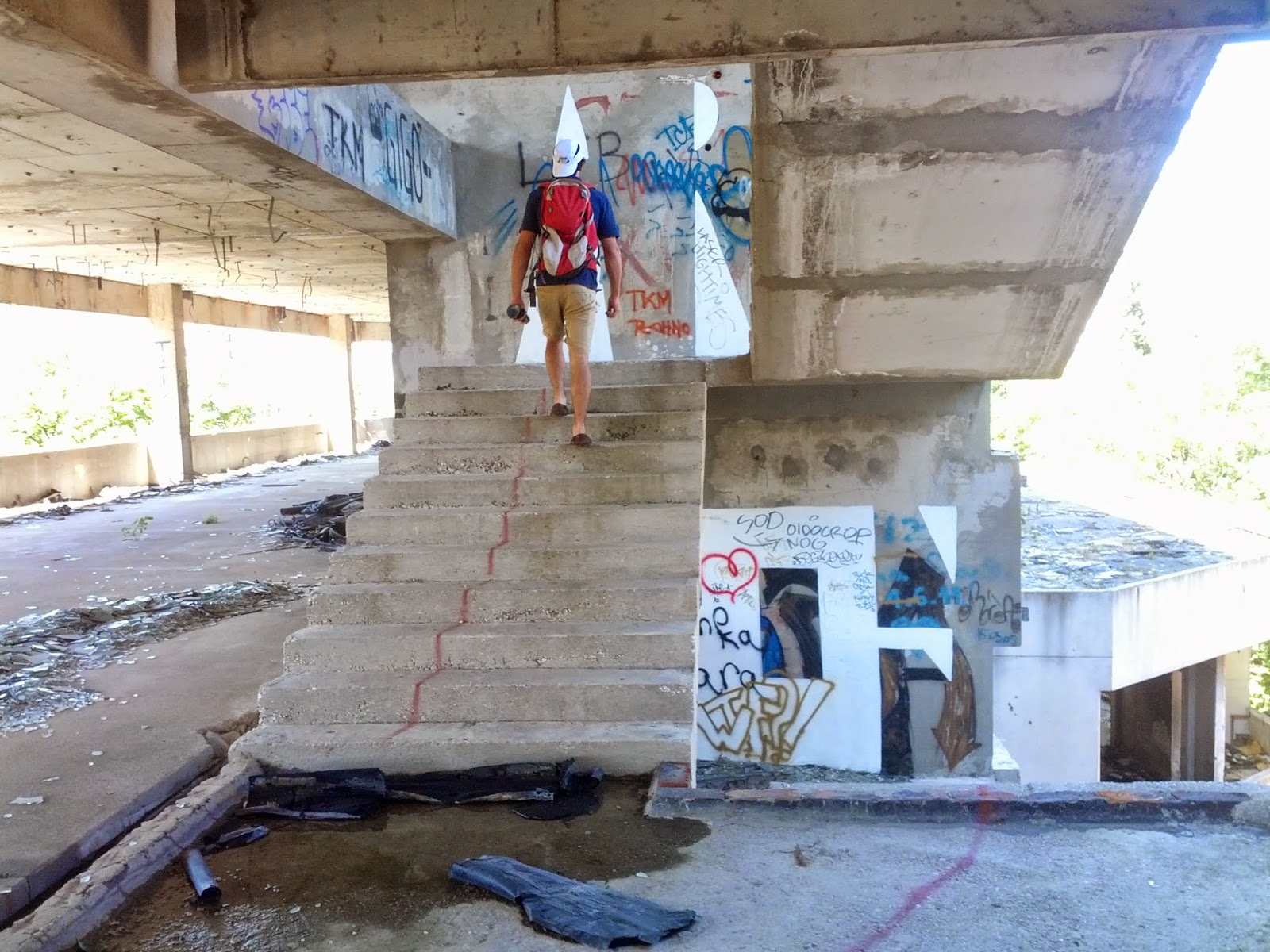
 
Luckily the stairs looked and felt extremely structurally sound and the only thing to contend with was the drop down into the alley way below as you advanced up the stories. On the third floor I saw the first distinctive triangular point, the thing that had initially drawn me to the building which I had seen in a rather obscure online article. Few people come here. Junkies and the odd curious foreigner that likes to get into the very heart of a place, that's about it. 
I walked towards the unsupported protrusion of grey concrete, noticing the sheer amount of frosted glass lining the sides of the room and the cabling, now well and truly redundant, hanging uselessly from the ceiling. The shelling was so relentless that literally no glass still remains in the window frames of the building. Mostar's past is very much in your face here. If you don't notice the numerous bullet casings lining the ground where snipers squatted, cleansing certain ethnicities of the civilian population, you will definitely notice the huge shell holes in the walls.

I stand in the very point, protected from a sizable drop by a thigh high railing of concrete. Looking out on the city below from this height I notice more and more how much of the city has simply been put in the “lack of funding” or “too hard” basket and left standing in the state the siege left it. The locals that lived through this period and remain in the city have daily reminders of their cities terrifying past. Its hard to imagine living through that and remaining in the city that delivered so much uncertainty, heartbreak and sheer terror. 
The building almost talks, raw emotion seeping from it, from the graffiti that lines the walls to the debris that covers the ground. Some beg for harmony. Others are have no relation to the past, artists have just discovered that this building offers plenty of open walls. I make my way up, eventually arriving on the roof. The city seems far below now and possibly the best close up view of the city lies below me but I cannot help but wonder what it would have looked like standing here a mere twenty years before. 


On the way down we notice a sub-roof. We hadn't seen any way on to it but searched around, finding a fire escape which does not line up to the regular stairs. This gets us onto the sub roof at the level of about story three with a short descent and small jump. This roof, probably once covered in tables for coffee and lunch breaks is now covered in a consistent ten centimetre plus layer of eroded broken glass. As the windows were all gradually shot out this caught the bulk of the glass. The glass doesn't crunch, its too weathered for that. It shifts, clinking a little. From the end of the roof you can look back up the line of points, making you notice just how high up you were at the top. I picked up a couple of casings and headed back to the exit point. 
We easily spent an hour and a half in here, wandering around. As I descended I noticed the light had changed, illuminating the ground floor considerably more. We looked around one last time and climbed over a different wall, avoiding the parts of the building that are favourites for junkies.

* * *

One afternoon Dan wanted to paddle through the city so I dropped him off and headed for the hills, wanting to find a way up to the cross that stands sentinel over the city. The back streets aren't exactly easy to navigate. I went down what may or may not have been a one way street for 1.5km, tucking in the mirrors as per usual. On another street I had to avoid a pot hole that was literally three quarters of a metre deep. Eventually I got on a narrow, winding road where I still advantaged from having the mirrors tucked which took me up into the mountains.
Soon valleys beyond Mostar began to open up and I reached the saddle below the hill I wanted to climb. The road needed to reach the top is tiny with a hair pin entry from the direction I was coming so I missed it, forcing a three point turn in a less than safe situation. I went close to five kilometres up the road hunting but found nothing reasonable. 

As I made my way up the mountain I began to see sculpted stones depicting the stations of the cross on the outside of hair pins. There was a fountain part way up so I stopped here for a drink and washed my face, warding off some of the heat of the evening. As I rounded a knoll the cross suddenly came into view. It really is a dominating construction, much bigger than I would have expected and the city seemed very far below. I sat for fifteen minutes or so, more than content doing nothing but taking in the panorama doused in evening light. 

Sunday, 29 June 2014

The Convoluted Coast of Dalmatia

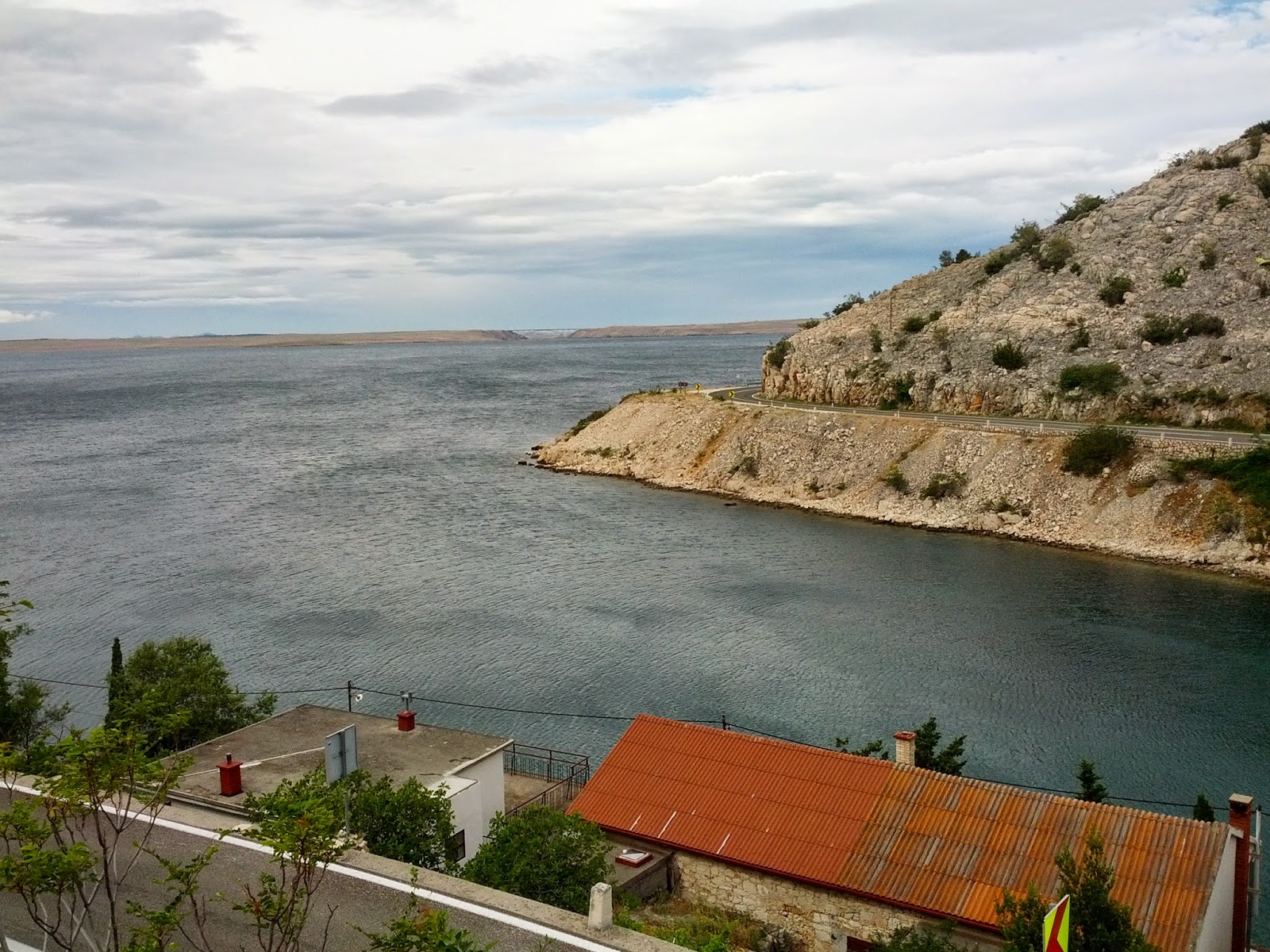
I reach out the window, handing my passport to the expressionless uniform-clad man in the booth. He critiques my stamps before scanning and stamping my passport. A similar thing happens in another hundred metres, this time at the whims of a different police force. Typical European bureaucracy. Seemingly minutes later the highway rounds a bend marking the transition from valley to hillside. Suddenly the vast Adriatic is stretched out far below, a blanket of consistently dark shades of blue juxtaposed against the aridity of the surrounding landscape. Its one of those things that causes a sudden sensory reaction. I don't think about it when I'm at home but we're so used to seeing the sea. I hadn't seen the sea in six weeks.
Olives and figs dot the hills, growing in whatever purchase they can find in the rocky, barren landscape. Few things grow successfully here. The salt leeches the nutrients from the sparse soil and the heartless wind, whipping at my hair right now, dictates vegetation height. The road begins to follow the sea proper, benched into the yellow hills, sitting at an average of perhaps fifty metres above the water. The landscape is undulating, forcing the meandering road in and out of numerous steep valleys. This means that distances on the map are rarely as short as they seem. Croatia is a relatively small country but traveling the length of it is a time consuming experience. Don't take this with any kind of negative connotation. The landscape draws out the length of your journey, but it's one of those road trips you just don't want to end. This point caused us to spend three days around a small town on the central coast, another three in Split and a couple of stopovers between drives. Bad idea.

* * *

It was getting late. “This place is too exposed! This place is too close to houses!” This kind of exchange went on for at least an hour until we found camping. In one valley we turned off onto an old Roman road, now surfaced in asphalt, etched into a steep hillside. Part way down it was blocked by a boom-gate which we raised. Of course. In the tiny cove at the bottom we discovered an off-shore fish farm and began to drive around, shining our lights in hollows looking for camping. Suddenly a dog came bounding over, barking ferociously. It came at the driver's side window, getting its paws above sill level. We quickly whipped the car around, tearing back up the steep hill. So that's what the boom gate's for!
On our first night in Croatia the local weather gave us its best. I doubt if the temperature dropped below twenty degrees overnight, teaming up with consistently strong winds to make a concentrated effort at impeding sleep. We camped outside a walled cemetery, not the first or the last time I might add, playing around to find the most sheltered spots. I weighed my tent down with blocks of unusually dense local rock, resulting in a cut corner pole housing and a frayed cable in the morning. Still, it was making the best of a difficult situation. After packing up on little sleep we pushed south to Paklenica, a climbing area we had heard rave anecdotes about in Ljubljana.

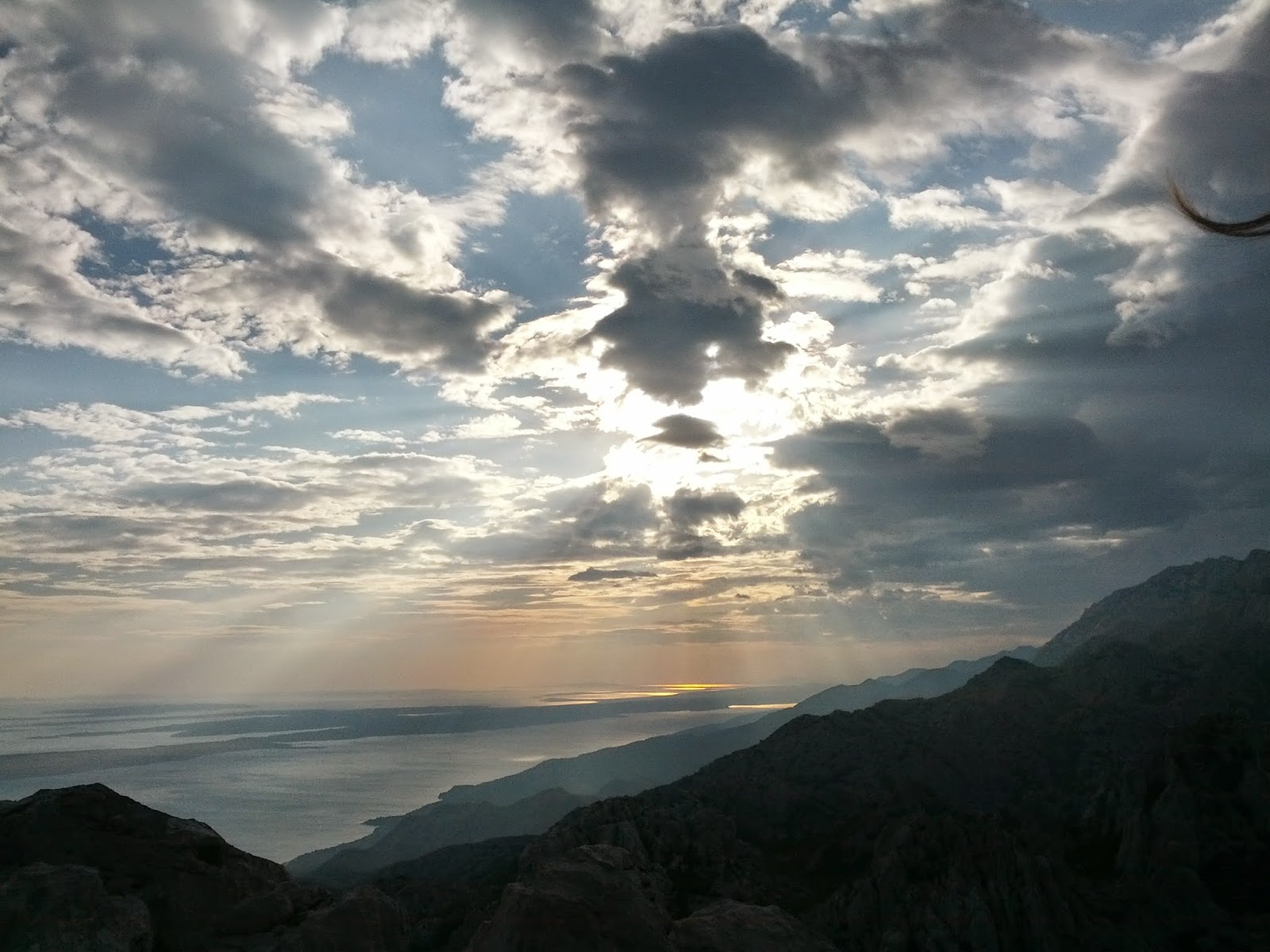
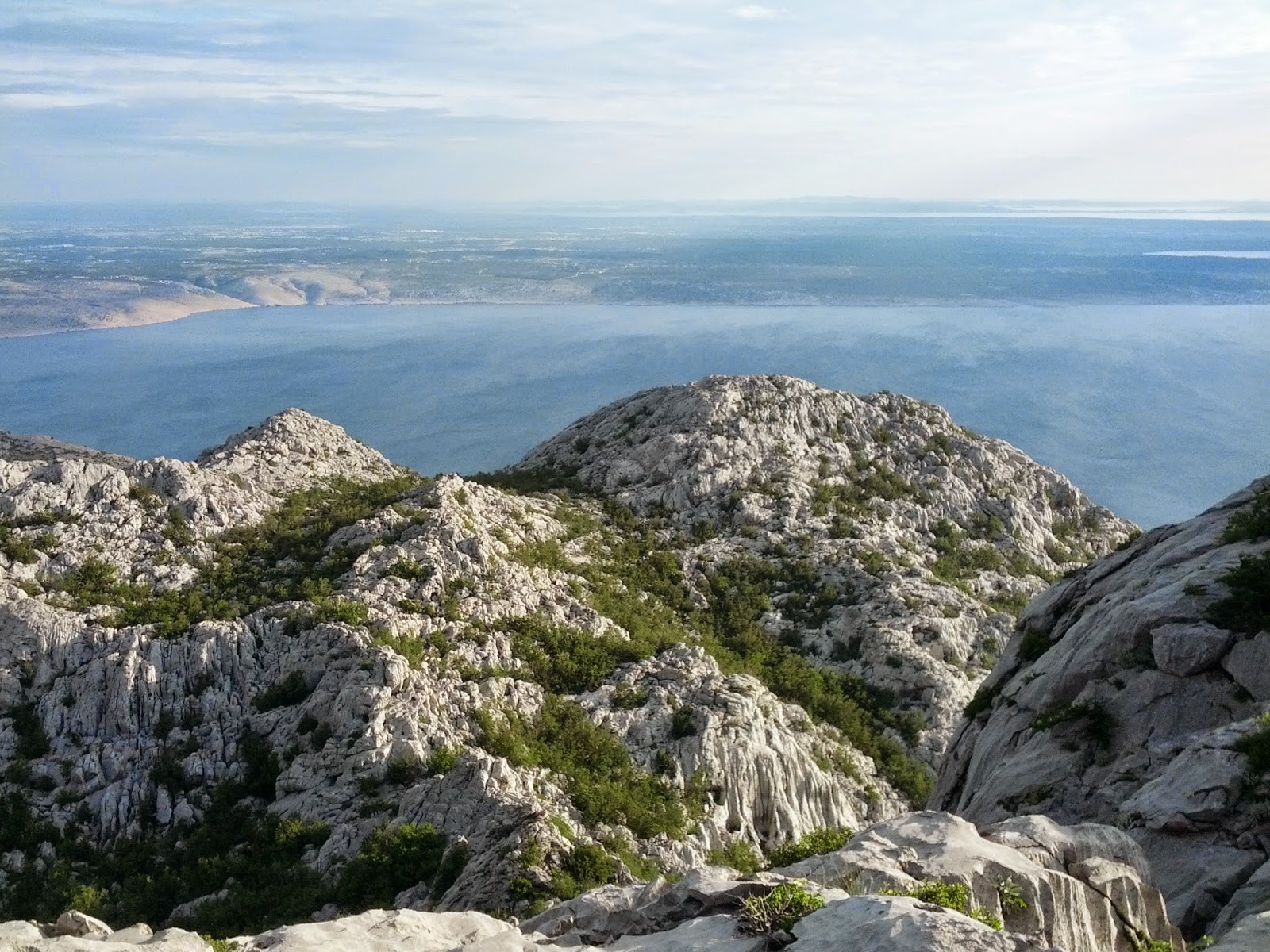
The park is a major attraction but for some reason finding the road leading into the huge canyon is somewhat challenging. We missed it twice on the first day, both times finding other areas of the park with their own charm to capture our interest. The little frequented northern part consists of numerous steep limestone peaks dropping straight into the ocean. The scrambling was fun and the rock was featured with ridges, pockets and striations like none I had ever seen before. We climbed a peak of respectable height by south west Tasmanian standards, catching the build up to yet another spectacular Croatian sunset. Most nights the sun limits its intensity to a single bright orange orb, slowly sinking into the ocean.
The next day we played on a large freestanding boulder, climbing a stunning arete on pinches. This was quite possibly a first ascent, being in a tucked away area of the park, obsolete to the typical traveler with the readily available mass-production climbing guide book. This area made for great exploration with so many small peaks worthy of ascents and multiple boulders with quality looking lines. It was a pity not to have more time here but three days had already passed and we only had just over a month available to explore the whole Balkans peninsula.

Every day without fail I visited a Pekara, or bakery, for the obligatory Burek. The Balkans probably makes some of the tastiest pastries of anywhere in the world at very tolerable prices. Burek is a sausage shaped pastry baked in a squashed s shape, in Croatia coming in Meso and Sir varieties, meat and cheese. The cheese is very much like ricotta except sharper in flavour and grouped in clumps. A Burek sets you back about two Australian dollars and is plenty for a light meal.

Balkans bakeries to me are like an addiction. If I see one and have not visited one already today then I will definitely go in. Best of all, this is actually the best way to feed yourself on a budget. A local I met in Split told me that Bosnia is next level because they practically invented the Burek, citing the availability of spicy potato, pumpkin and cheese and spinach varieties. This was cause for excitement as this inland nation was our next planned destination.

On our second night we camped by the water. I don't think you're technically supposed to camp outside of designated areas in Croatia but two other groups were camped here with us. It was obviously a well know spot to climbers seeking free camping. We propped the bouldering mats up on trees, forming couches and cooked dinner, the water calm and relaxing. The light faded soon after the water began to boil, a typical occurrence. Our body clocks have definitely adjusted fine to late Mediterranean dinner times.
In the morning we checked out Paklenica gorge before continuing the drive south. The park has an entry fee but no one was on the gate or visible in the information centre, making it de-facto free entry. No raised voices followed us, confirming this conclusion. We parked where the canyon narrowed to a pedestrian only zone, huge limestone walls towering above on either side. The gorge would struggle to be more than 50m wide for the first 200m or so, an impressive spectacle when you notice just how high the walls are. The entrance to the canyon is not far above sea level yet the canyon walls give way to steep, rocky monoliths piercing the 1600m mark.
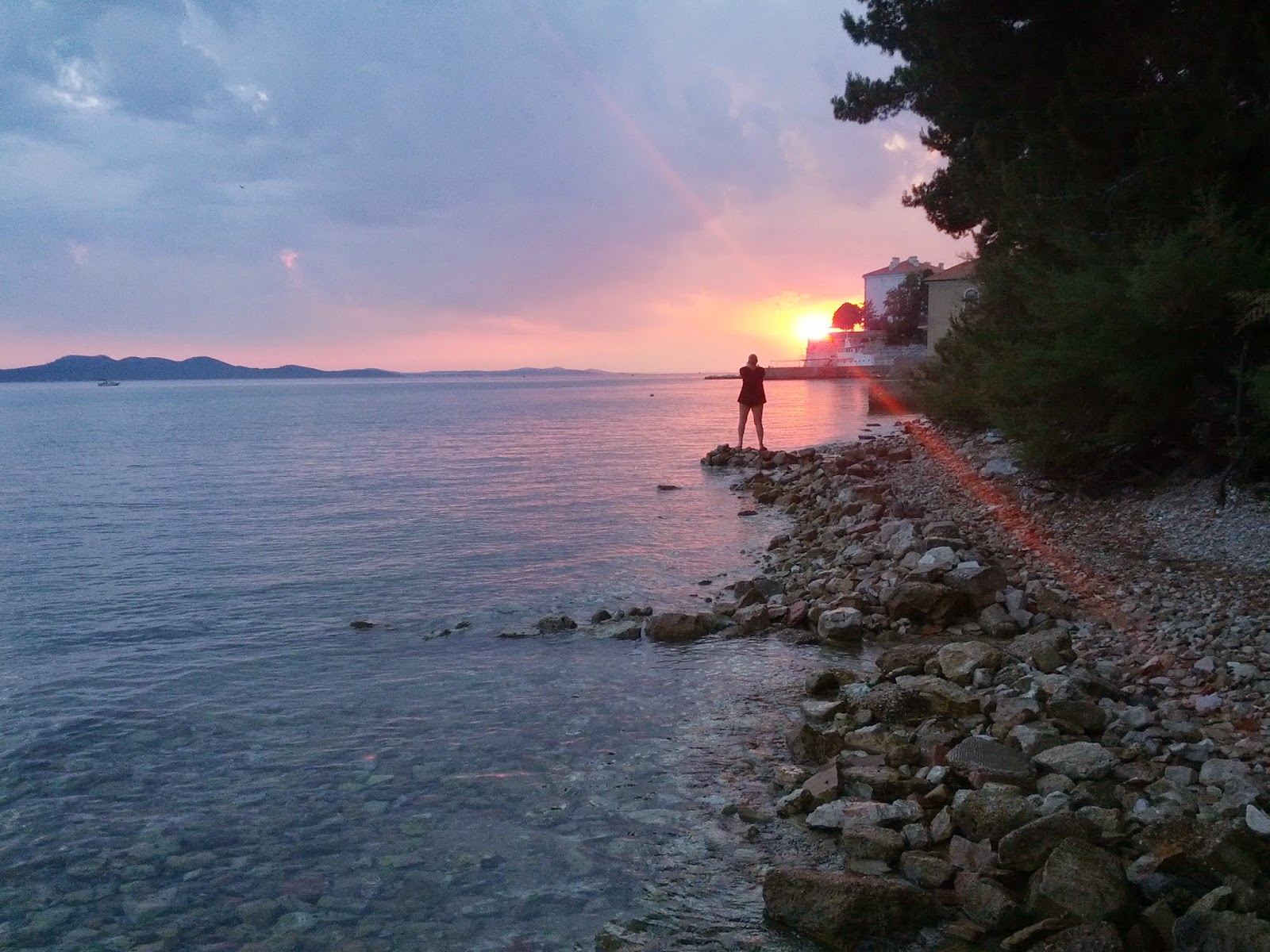
After checking out the limited bouldering with another round of free guides, photos taken of guidebooks as per usual, we continued down the coast to Zadar. We cooked our evening meal by the ocean, frying seasoned kebabs and following it up with carbonara. It was our best self-cooked meal yet, solely because it was our first time buying not-so-simple food. We cleaned up just as the sun dipped to that point where it illuminates the ocean, playing in the slight depressions between the subtle chop. 
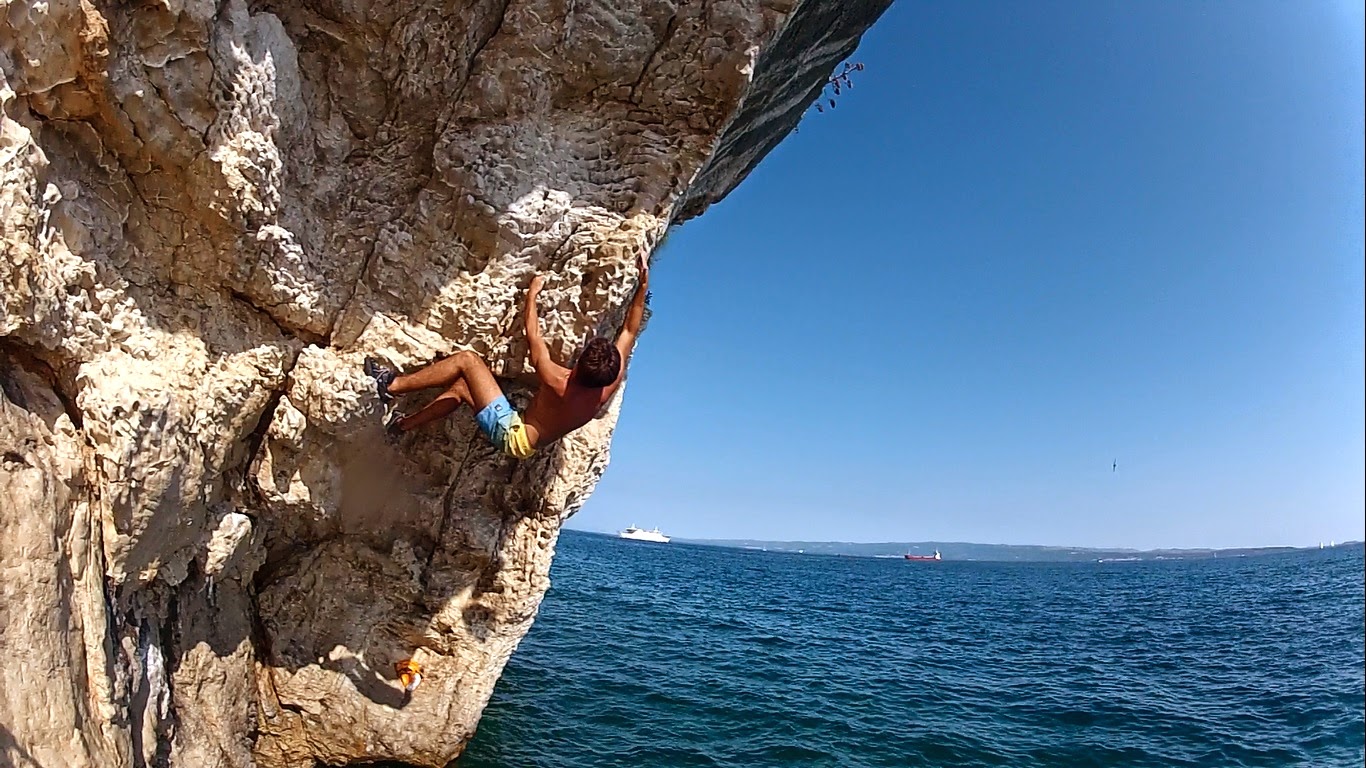
Split, Croatia's second biggest city, has great deep water soloing. For those of you that don't know that means route climbing utilising deep water rather than rope as a safety net. This and the historic centre made it a natural next stop on the coast. We got in mid afternoon and found a free park in a deserted area of the port, watching numerous cruise ships deposit throngs of Americans and Brits on the wharfs. The city's adjusted itself well to pulling in tourist dollars, converting what was once an industrial port into a harbour capable of holding as many luxury liners as possible. 

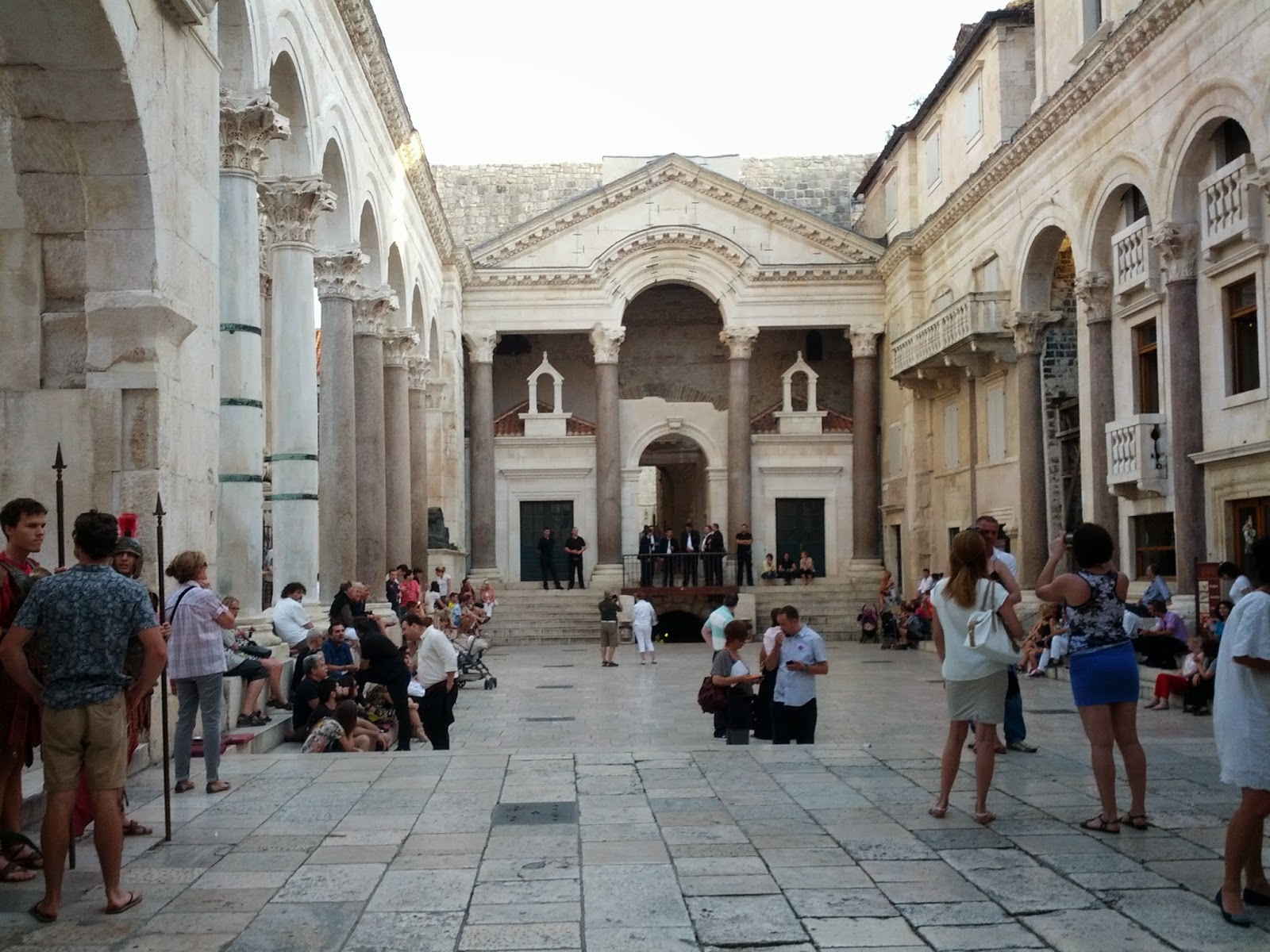
The historic centre is littered with lines of Corinthian columns, sometimes supporting roofs and reaching up two or three stories, decrepit reminders of the extent of the Roman Empire. We moved with the sea of tourists, in one square coming across a local wedding. We tried to get away from the water as fast as possible but the tourist numbers simply didn't decrease. Split's historic core can only be described as feeling like yet another western European tourist trap.

Then we headed north. Things began to change. We popped down an alley, emerging in a bustling street sporting numerous bakeries, a supermarket and a couple of restaurants. American accents were no existent and Shtokavian, the language formerly know as Serbo- Croatian under former Yugoslavia, became much more prevalent.

That night we camped in Sustipan, within the high walls of another cemetery. Yes. Within this time. Today its merely an enclosed park with a small mausoleum but thousands were supposedly buried here during Roman times. Ignoring the previous, it was idyllic. The walled park sits perched above 10- 20m high see cliffs on a prominent hill overlooking Split harbour. A mere ten minute walk from the city and you rarely meet any non-locals. Bliss. We stayed three days, camping in various places, using one particular local cafe we liked for WiFi and climbing on the cliffs.
It isn't even late summer yet and the water reads in at a pleasant twenty-two degrees. In the heat of the day its easy to spend hours in the water, swimming straight off the rocks in deep water, a better alternative to the often pebbly, uncomfortable sea floor you can find at Croatian beaches. This place was exciting. I had done a bit of deep water soloing at home but never on rock this steeply overhanging and definitely never in a setting with temperatures this comfortable. On two different days we were here when the sun went down. 

On one night we met a local who spoke great English to the point that his expression was extremely animated and included many semi-subtle jokes out of understanding of the nuances of our language. The three of us had a beer together and discussed everything from linguistics to the limited bouldering in the Balkans, our new Croatian friend laughingly saying that the latter is because everyone picked up all the boulders in the whole area and dumped them in Macedonia.

The following night we had beers with Nikola, another friendly and hospitable local I met at the local deep water soloing spot. Getting to know a few locals painted an interesting picture of local life. Everyone is so curious about wages, welfare and the like in Australia and are awed when they hear how damn good it is, stimulating a reaction I can best describe as longing. Things work differently in Croatia. Locals freely describe the culture as lazy, illustrating this description with examples of work hours and the amount of effort required to make money in certain jobs.

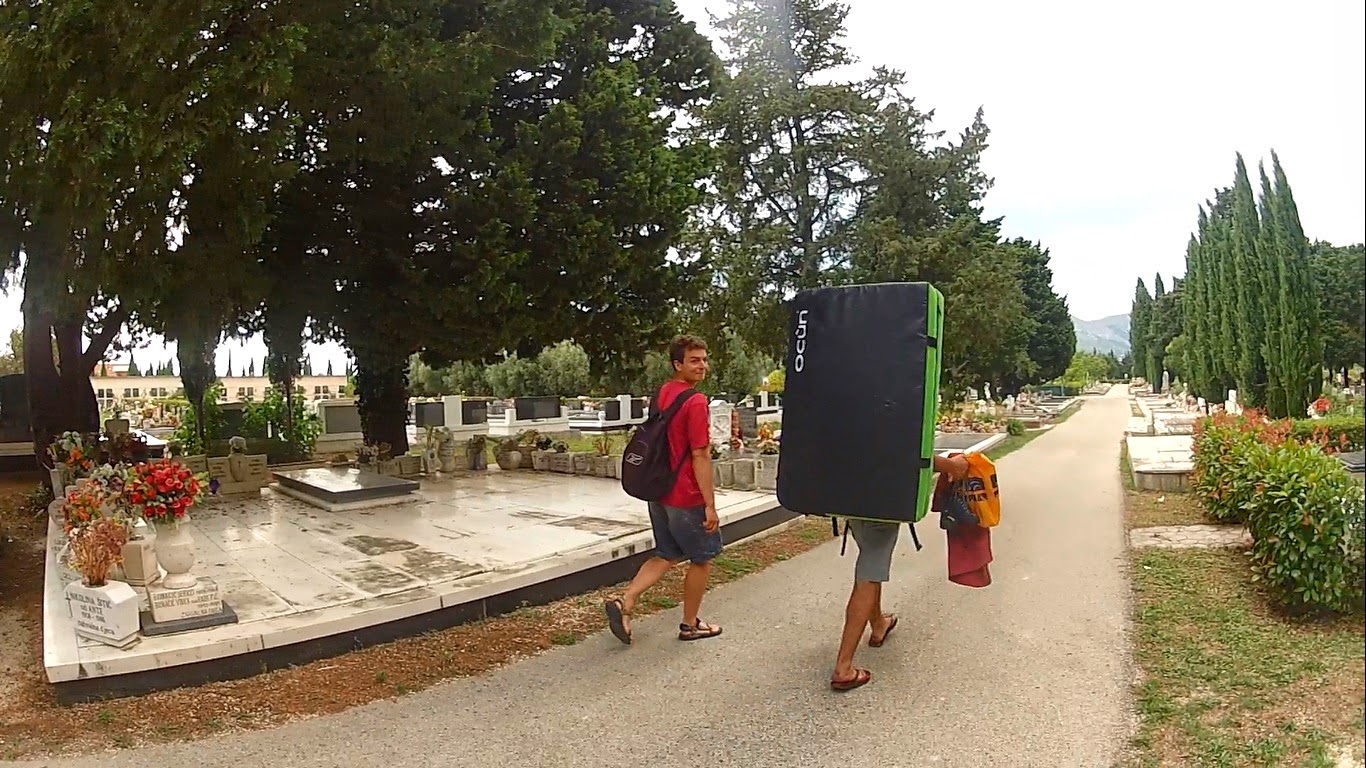
On our last day Nikola showed us a bouldering spot friends had told him about which happened to be located in a cemetery! We walked through this elaborate cemetery called Lovrinac with crash pads and climbing gear in hand, barely drawing the attention of mourners. The climbing is pretty well hidden from sight of the graves, rimming a small knoll that has been hollowed out to contain a war memorial. A guard informed us on the way out that climbing has been banned since the cemetery expanded but he showed no desire to do anything about it. This seems so common in Croatia. Rules are subservient to understanding; why disturb people who are doing no harm?

* * *

Eight days after entering Croatia near the coastal city of Rijeka we found ourselves in the southern town of Omiลก, spanning both sides of the River Cetina's confluence with the sea. That first day when we popped out on the coast that time period of a bit over a month seemed indefinite. Not so. Now I can look back and see the time we spent not doing too much, content, but again, not doing too much, could have been better spent. There's so much I want to see in this fat, oversized peninsula. But now I know better. I plotted it out the other day. Over two thousand kilometres of road awaits. 
Approaching the next border crossing

I currently have coins in five currencies, all stored under the hand brake


Wednesday, 25 June 2014

Probing the Roof of Slovenia

“Make sure you put the small bouldering mat underneath the big one so we can see out the back a little better,” Dan suggested as we packed the car. We each have a foot well where we organise our clothes, shoes and various pieces of gear. For me that's a via ferrata kit, a harness, chalk, a day pack and a couple of other things. “Your pack's wider, lets put mine in first so we can get the bulk of the gear into the back and have the food at the front,” I said as we began the jigsaw puzzle like task of packing the boot.

These tribulations are typical. One of us often holds the boot up while the other packs or unpacks as the boot cannot sit open with a kayak strapped to the bare roof. Wind things back a couple of days and I was liberally throwing things in the car, only having to worry about one person's gear and certainly no kayak as Dan was using it to race in his debut world cup. I would organise myself in Mojstrana, a small Slovenian town before my trip into the mountains.

Upon arriving in Ljubljana I stepped off the bus to warm temperatures and headed straight for the historic centre surrounding Ljubljanski Grad, the castle that stands sentinel over the car-free old town radiating from a channel of the river Sava. I headed to Annapurna, an outdoors store, to visit the very hospitable man that owns it whom I had met previously. Two hours later I left with ice axe and crampons in hand, suggested “precautions” against the remaining snow and ice that turned out to be a necessity.

As my pack was full I strapped the ice axe to the outside, quite a spectacle in the crowded historic town centre. The Slovenian police certainly found it interesting because they hailed me down and questioned me for carrying a weapon in a public place. They seemed a little confused about its purpose which I thought was weird for Slovenia but when I mentioned alpinism their interrogative tones became curious ones. I'd even go to say they turned into tones of delight when I mentioned Triglav, a symbol of national pride. 
It was late before I left the following day because I waited until I could meet Mathias, an Italian friend, so I could get my insulated jacket back. I somehow forgot to pack it when I left Merano but he had luckily been able to pick it up. I thought it might come in handy with snow down to 1300m when I planned to get close to 3000m.

Leaving town at about four in the afternoon I drove north in moist, drizzly conditions that developed into full on torrential rain. I found it so hard to see out the front windscreen in the heavy rain that I had to sit in the overtaking lane, sometimes overtaking cars, for the sole purpose of only having to endure rain rather than heavy back spray from cars as well.

It cleared a little as I entered Mojstrana so I drove up Vrata, a valley with supposedly awe-inspiring views of Triglav's north face, a mountain that seems to well pride up inside each Slovenian when its mentioned. It's a national icon, even appearing on the country's flag and was my goal for the weekend. Or what was left of it. It was a Saturday night.
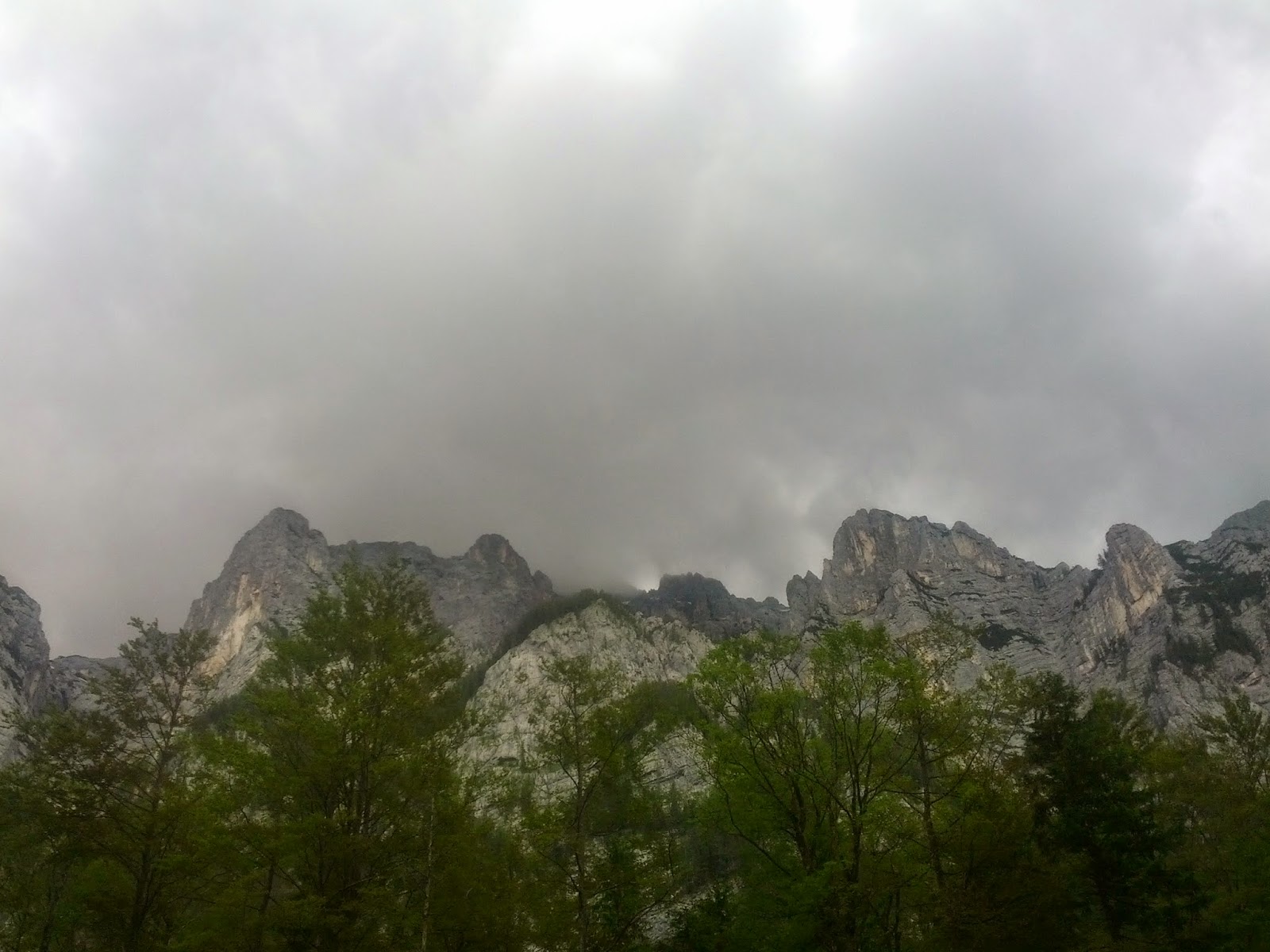
The road soon changed to gravel, the only exception being the steep bits that reached a whopping gradient of 25%. The road was merely one lane wide. I certainly wouldn't want to meet another car on a hairpin with that kind of gradient. Luckily I didn't but unfortunately my efforts offered little reward. I drove 10km up a steep, narrow road for non-existant views of the surrounding mountains, the peaks entirely shrouded by cloud.

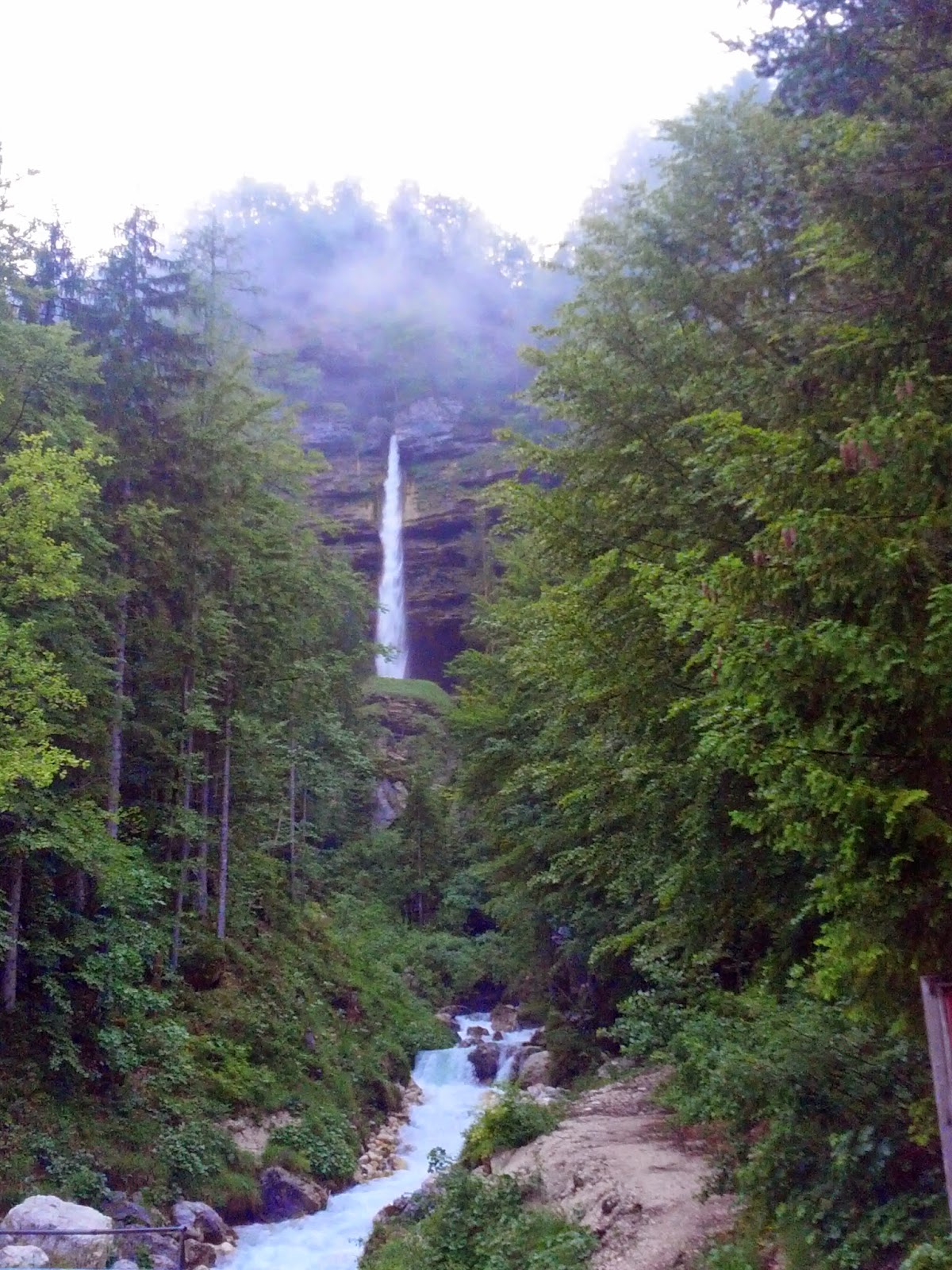
However, part way down there is a 50m waterfall that is low enough to be unobscured. It seemed mystical in the moist conditions, tendrils of cloud wisping in the valley and creeping in between the pines. The road cuts through extensive beech forests, the leaves having a surreal colour and brighteness in the unusual mottled light. I descended Vrata, camping just outside the town limits for the night. As per usual I wasn't disturbed. 
In the morning I drove to the head of Krma valley, the start point for Triglav's normal route and began to pack my gear. I packed everything and went to strap my crampons and iceaxe to the outside of my pack. Only to discover my crampons weren't there. And it hit me. The night before last it had poured and to protect my gear from the rain I left it in the Australian team tent at the world cup. The crampons were in an inconspicuous brown paper bag and I had completely forgotten to pick them up as they probably weren't obvious in the fading light. That also meant I had no woolen socks as they were in the same bag.
Fighting off the sinking feeling curbing my high spirits I drove 12km back to Mojstrana, bouncing across the scree field on the road with multiple trenches and scraping on one of the drainage ditches. It's some road, in most places it feels like you're driving in rally style if you're hitting 50km/ hour.
Krma Valley
Putting the ice axe to good use
When I returned to the town it was only 7:15 in the morning. I saw some locals and approached their balcony, thinking they would be having a morning coffee but they had already sunken four odd beers each. Despite this they were very helpful and hospitable, inviting me in for a morning brewskie and to discuss the mountain that looms above their town they love so much. None of them had crampons to lend me unfortunately but they referred me to a family business. This was a dead end, all their gear was already lent out. I had no idea why, the area was deserted. I saw a handful of people in the mountains if that, let alone people that were kitted up to have a stab at Triglav.

Dejected, I drove back up Krma, at least determined to reach Krederica, a hut at over 2500m, for the night. Crampons are only required for climbing above the hut. I set out at close to eleven o'clock after lengthy efforts to acquire a pair. The track was in a much worst state than I expected, covered by what must have been close to fifty fallen trees in the lower section, consuming a lot of time. My spirits instantly picked up when I cleared the tree line, getting a panoramic view over the glacial valley below. After a tiring ascent on loose gravel, probably better described as rock, which surfaces the track I hit a beautiful alpine bowl. I sat down for a rest, watching a pair of deer frolic in the corner and the odd marmot dart in and out of shelter.
Getting Higher
Alpine Bowl
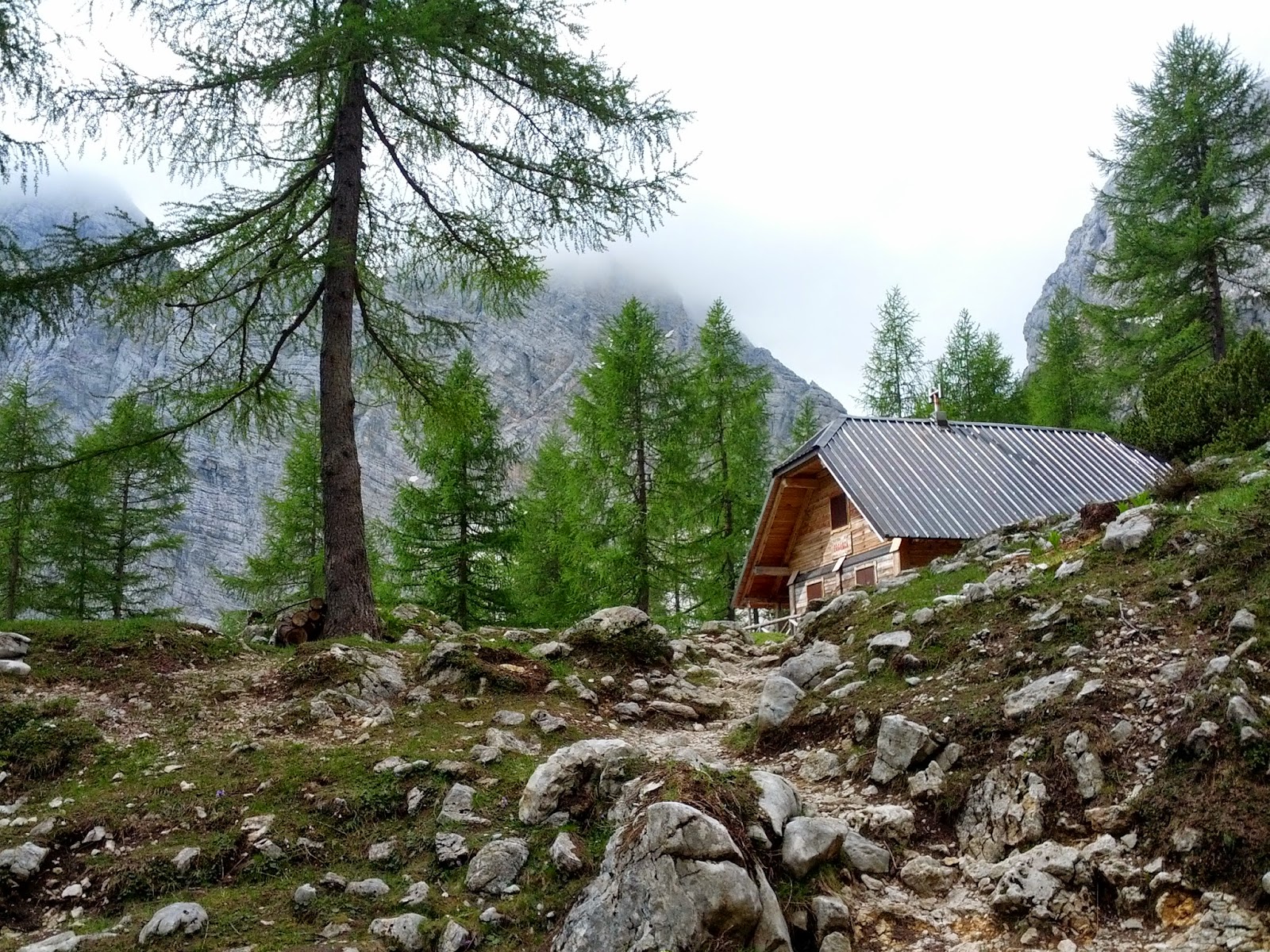
A bit higher I hit a hut at over 1700m, making me feel elated as I already had 700m of elevation gain behind me. The hut was in a beautiful spot and I was tempted to spend the night here as it was free and had interesting features around it. It was early though and I wanted to see the higher reaches of the Julian alps so I pushed on after a half hour break. Instantly after the hut I hit snow that I actually had to walk on, chilling my feet that were “insulated” by two pairs of cotton socks. The route was marked sparsely by painted white circles and after another 300m of climbing it disappeared almost completely. After following footprints through a firm snow bowl I was on my own.
There were few signs of previous passage above this. This worried me a little but I pushed on, setting six o'clock as a turn around time. This would give me 3hrs of day light to return to the hut I had previously visited. I pushed up, constantly slipping over on the steep snow slopes. I ascended perhaps five hundred metres on steep snow that approached 45 degrees in places, using the ice axe for balance and occasionally to halt a slip. After two or three hours of steady but tiring ascent I saw a couple of snow poles on a ridge and aimed for these, crossing the steepest section of snow yet. I had a long rest, taking in the improved panorama of the mountains.
After a little work on loose rock and yet more snow I was at the hut, a mere half hour's walk from where I topped out on the ridge. It was deserted. I walked around it, not seeing anyone inside but to my surprise the front door was open. I met two meterologists, the only other people on the mountain. They spoke very little English but one invited me to climb Triglav with him the next morning. Not having any crampons and having no access to spares at the hut it was a no go for me. This is as far as I would get.
The deserted rifugio, or mountain lodge, was an eyrie place to be entirely alone. It simply didn't feel welcoming at all when it would usually be populated by at least twenty people in the peak of summer.
The hut was filled with paintings and topos of the surrounding mountains
I sat my stuff out to dry before climbing a nearby hill, probably reaching around 2600m. I sat cross legged for around an hour in the cold, wearing almost all the layers I brought, taking in the landscape and enjoying the solitude. This was the last thing I expected. I was told how popular it is and how even in harsh conditions like this I should see five or so people at the hut. This simply wasn't the case. I wasn't that disappointed I couldn't reach the top, in that amount of snow reaching the hut solo felt like an achievement.
Morning Weather
In the morning I woke to thick fog but I could remember the ascent route perfectly and had no problems locating the correct gullies. The descent was much faster, taking as little as a fifth of the time it took to ascend. I skiied down the snow on my feet in places, using the handle of the ice axe for stabilisation. I popped out of the cloud around 400m below the hut to be greeted by a sunny day and wandered slowly back down the mountain, enjoying the sun and having gravity on my side for once. I must say though, 1500m of descent in 2hrs certainly kills the knees. As I neared the road the cloud base was just beginning to drop again, testimony to the fickle mountain conditions.
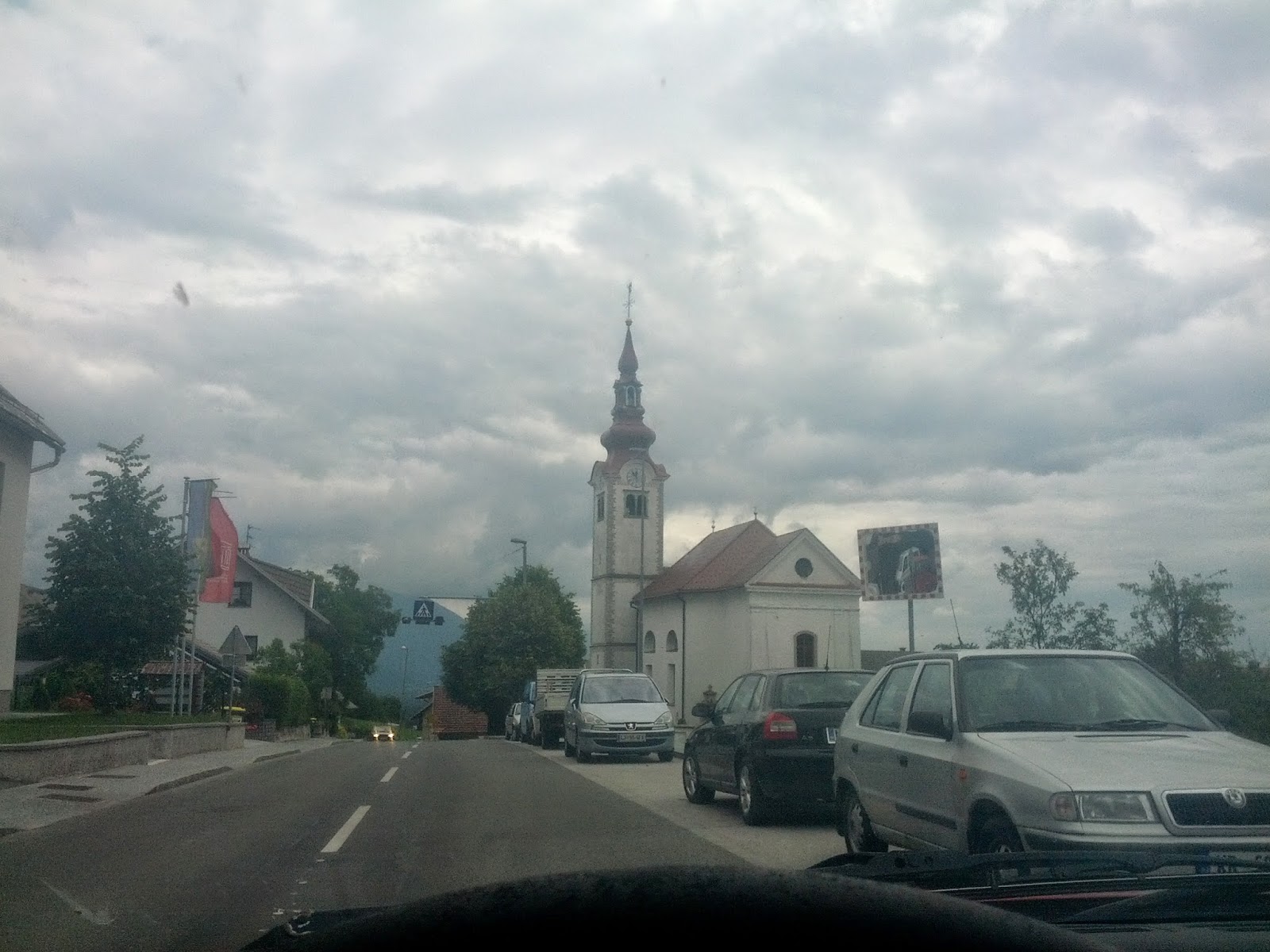
Getting back to the car I drank around a litre of water from the fountain and drove a dirt shortcut to Bled, passing several pictruresque towns. I've learnt well and truly by now that a bridge sign may just as well be a stop sign as the bridges often have one lane, if that. This time I entered Bled through the town itself, not the tourist metropolis. I spent another hour or so by the lake shore, having enjoyed Bled so much the first time, before getting back in the car to return to civilisation proper, only making a brief half hour stop. The air was moist this time, many of the mountains obscured, but the place has charm in any conditions.

Leaving the lake shore I got back in the car and drove almost half way around the lake, ascending the steep little road to Bledski Grad,  Bled Castle. I'll have to admit, there was the occasional moment where a tour bus really made me cringe. Meeting coaches on hair pins is not fun. I didn't go inside the castle but found a place high on its walls where I could sit away from the tourists and dangle my bare feet over the lake far below.