Monday, 18 August 2014

Meetings in the Strangest of Places

The sun was still strong as I passed through the dusty valley, blaring down relentlessly despite being a mere two hours off sunset. As I exited its gates a section of tooth-topped wall appeared over a hill. I was very close now. I was excited to say the least. Signs demanding you slow down for the town started appearing and after two more bends I was gazing up at it. High walls lower down, mainly serving to retain dirt, were capped with houses and in turn churches and public buildings on top of that. A fortress sat at the left fringe, once a refuge for the town's population in case of attack. A high, improbable wall on an adjacent hill serves to fortify the right side of the city where I stand.

Albarracin has to be one of the most beautiful towns I've seen in Europe. It sits in an arid landscape, the only trees limited to a plateau like area 5km out of the city and around the rivers. Once it would have been one of the biggest centres in the region, reflected in the strength of its engineering and the grandeur of its landmarks. Today under 2000 people remain in this beautiful, albeit isolated monument to the Aragon of old.
.
I did not have time to explore the town when I first arrived. I frantically drove around, trying to find signs of where the bouldering might be through trial and error. I passed through the tunnel under the town and drove 3km through a spectacular ravine which would have once helped to protect the city from intruders. The floor of the ravine is perhaps the only easy access to the town that would have existed from that side. I could see no sign of the bouldering. I found a place to make a three point turn and quickly retreated.

The next road I took lead to the tree covered plateau and somehow managed to be correct. As I drove higher an outcrop of rich red rocks beaconed to me, sitting high above the surrounding landscape under the full grasp of the intensity of the sun, a mere fragment of the perfect sandstone that exists here. At the moment Albarracin has about five thousand problems that are actually written up in the guide. It seems there would easily be scope for that many again. 

I easily found the climbing once on that road. Shortly after the road leveled off I found a carpark on the left with a few vans and people that were clearly climbers. I parked here, quickly grabbed the crash pads and my gear and sprinted off to make the most of the daylight I had left. By daylight I'm talking 15mins until the sun set and maybe another 45mins of twilight after that. 

I stopped at the first climbing area with other climbers and started trying a random problem. I asked someone what grade it was and he said 6b. I got my hands on the lip second go but from there could push no further. The top out was incredibly slopey and had at least three more moves until you could get your body above the lip, all desperate slaps for slopes high above the ground.
I gave that one a rest and instead climbed a 6a. The top out was still slopey but it felt manageable. I had it done within three pushes. By that time it was dark so I packed my things and headed back to the river where I rested earlier. I set up my tent on the other side and started cooking at about 10:30, just enjoying the sound of the breeze in the trees and the water rustling the rocks on the river floor, all alone.

The next day I woke late and headed into town. Parking in Albarracin is free and easy to find which is always nice. I walked up a few steep, tight, cobble-stone laneways which deposited me besides the colonnades ringing the town square. The Ayuntamiento sits on the outside, displaying both the national and regional flags. Tourists, all seemingly domestic, stand on the tiled floor next to it, posing for pictures against the pillars with the surrounding landscape extending behind. 


I searched for WiFi but found nothing. A few months before a friend back home who had spent close to a year on exchange in Spain had introduced me to one of his friends that lives in Escorial, just outside Madrid. I wanted WiFi for the sole purpose of checking on our meeting arrangements. Oh well, I would have to drive an additional 60km to the arranged meeting time and risk having to wait a long time. It was no big deal.
I walked through the streets, saying hello to a few of the numerous locals who sit on ledges outside their houses for most of the daylight hours. I gazed up at the cathedral, standing on its terraced square. I crossed town, delving into its depths, getting into alleyways where I started to see no tourists at all, purely residential areas of town with no car access. I simply wandered. 

I spent three hours in the town just enjoying the atmosphere before I moved. At 2pm I got back in the car and begun the drive to Huelamo. Little did I know at the time but Huelamo is a village of around 200 people. Pablo, who I was meeting in Huelamo, would later tell me that the locals had said, “So you're from Madrid and he's from Australia? You're meeting in Huelamo?! He won't show up!”

I spent most of the drive to Huelamo guessing. Huelamo didn't appear on any of the signs so I was relying on my poorly loaded phone maps. I had a vague screen shot of a route so roughly new a couple of towns I needed to pass through. It took one hour to drive the 57km but all of a sudden I found it. A sign on the left pointed to Huelamo which stood on a hill one kilometre away. I don't know how I arrived there but I did. As I drove up the hill I saw a lone figure silhouetted against the sky, standing on the summit of a pillar of rock, towering above the city.

I started walking through the town, contemplating what to do next. I asked a few locals about WiFi and they directed me to one of the the town's two bars. They have one bar for every one hundred heads of population. I also asked if they'd seen any “extranjeros”. Outsiders. They said no. Being a small town I was hoping that word would have spread fast when someone from out of town had arrived. Maybe he wasn't here yet.
On WiFi at the bar I discover that Pablo had arrived the night before and was staying in a place called, “El Baile”. I was a little confused as I guessed it was a dance studio.

I knocked on the door. No answer. I sat down, thinking I'd give him ten minutes before I try and find him some other way. He turned up within five and introduced himself. It turned had the villagers had indeed put him up in the local dance studio. We had a standing offer to do the same that night which we gladly accepted.

We sat down at the bar, at that point two complete strangers, to get to know each other a little. The hospitality afforded to us was unmatched. Before long we a pitcher of water was brought over and we were given a plate of pasta each and some meatballs. I soon found out that the owner also wanted to take us to a neighbouring village to watch a traditional game of bowling.

In the evening we were seated in Agus', the owner of the bar and a real personality, four wheel drive. The drive to the next village took about half an hour. The game was certainly interesting. Two teams play off at once in a small, dirt arena. Using big balls they aim for ten pins, widely spaced, with the intention of knocking as many over as possible. The distance they shoot from is rather close and on their second shot even closer as they get to throw from behind.
View from our "accommodation"
On the way back we took the mountain road where Agus showed us his skills with the handbrake and told us about how he never pays fines because the only thing in his name is his car. “And the police won't take that!”, he ensured us.
Back in Huelamo we spent a bit of time at the bar before going to a barbeque with the town's young people. There is a small group of people in their twenties of so, a few kids and a few in their thirties. Huelamo, sadly, definitely has an ageing population. It was two in the morning before we were in bed on the floor of the dance studio. As I was getting off to sleep I couldn't help but think about how accommodating the whole village had been to us as outsiders and how far out of their ways they'd gone for us.


In the morning as we were leaving they said we should return for their festival later in the year. I told them I'd love to. The truth is I would but probably won't get to.

For the Love of the Open Road

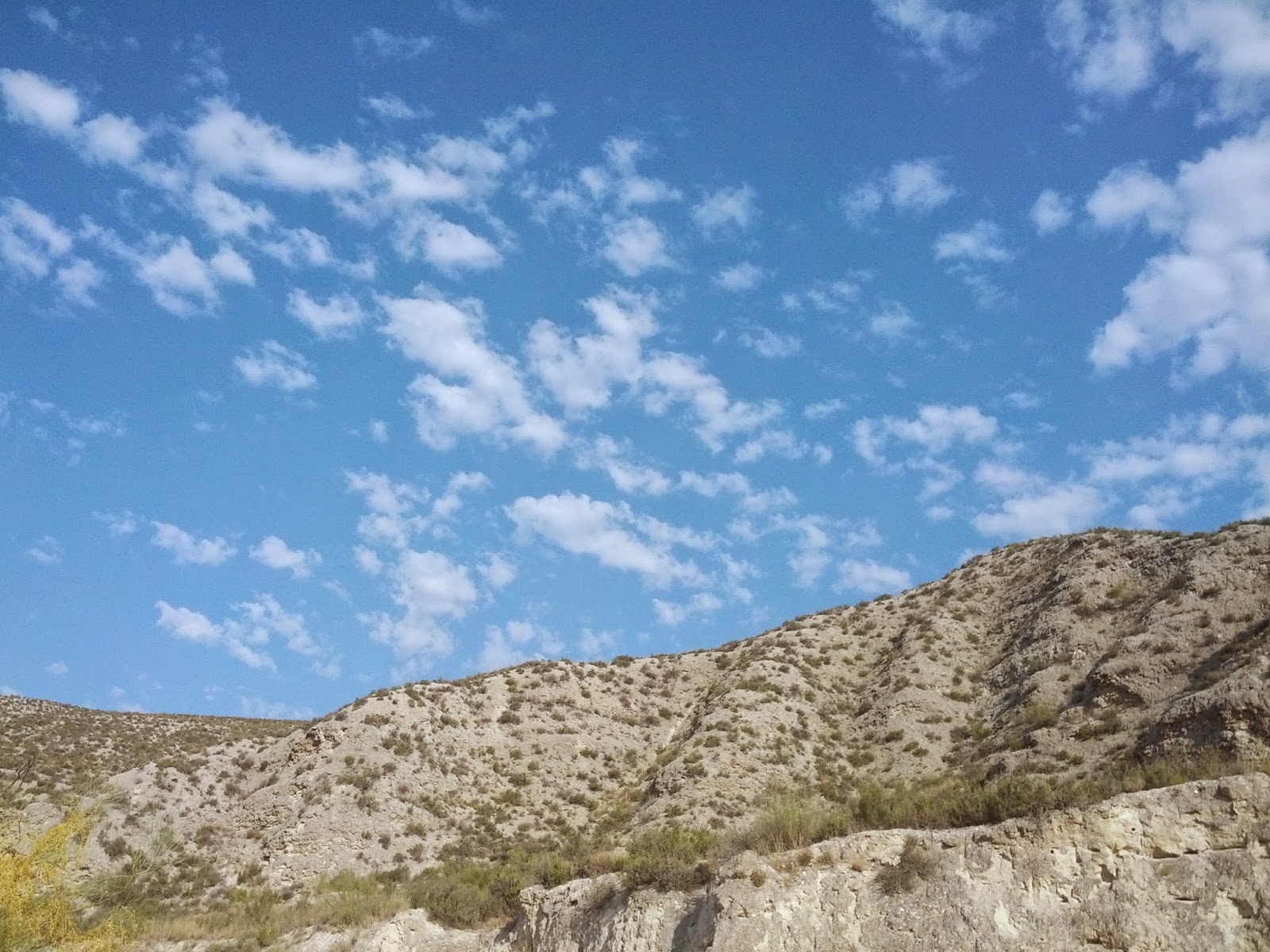
I fly past three trucks in one go, courtesy of a huge straight stretch of tarmac plastered on the arid landscape of Aragon. Aragon is almost like a desert. Huge open skies. Large expanses of sandy or sepia toned earth. Barren hills.
 The trucks were probably going about ninety. In the interest of saving fuel I probably should have sat behind them, but I didn't. I love being able to stare out over the open, unobstructed landscape in front of me. Despite the journey between Lleida and Zaragoza not being that interesting I thoroughly enjoyed the drive. It felt like freedom. That might sound cliche but I don't know how else to describe it. The rush of warm air through the two open windows while going over 100km an hour, the distance I can see over the dead flat plains in front of me.
I camped in the desert that night, wedged between two sand hills. After setting up my tent in the dark I laid out on a crash pad for a long time, enjoying what the night sky looks like with no light pollution for the first time in ages.

In the morning the heat hit early. Lizards skimpered across the baked earth, perhaps also looking for asylum in the shade. I quickly packed up and drove the remaining distance into Zaragoza. I passed along wide boulevards, one terminating in a round-a-bout with a huge obelisk at its centre. Eventually I managed to find a park in a quite residential area, a mere 500m from the river opposite the city's iconic cathedral. I spent most of the day under the shade of the oaks, by a fountain, amongst high buildings. At about one pm the city entirely cleared out, the heat causing the population to flee for the air conditioned comfort of their homes. In the peak of the heat I ended up dozing off, my head resting in a weirdly comfortable root of a huge tree.
In the evening I finally left the city. I bought some food at a supermarket that had strangely good prices. Five kilos of a combination of nectarines and two varieties of peaches cost me all of two euros fifty.

I struggled to navigate while driving, looking at my phone every so often but mainly just aiming for the outskirts of the city hoping to see signs to the Teruel, the capital of a province by the same name. I did soon enough. Then a hail storm hit. The intensity was ridiculous. The wind screen wipers couldn't cope with the intensity and I just had to stop and wait it out. It lasted about 15mins. I got out of the car, expecting to see torrents of water gushing through the sandy earth. There was nothing. No evidence at all of the intensity of the storm.
For some reason none of the signs for the national roads pointed to Teruel. Only the Autovia signs. After being tricked into getting onto the Autovia several times I finally just commited to the national road. It took me where I wanted to go. It seems the signs are a clever ploy to try and get you to pay tolls. Thankfully I didn't have to pay any.
About 40mins out of Zaragoza the drive improves drastically. It enters a semi narrow valley with several nice towns before reaching the beautiful historic city of Daroca. Very little of the city is modern. It's amazingly well preserved. The city is built in a depression against the fragile mud cliffs of Aragon, also the material of the city walls. Most of the city walls are a mere shadow of their former constructions, the only available building material, a gravelly kind of mud, having been eroded away by hundreds of winter thawings and the ravages of wind and rain. 
There are also several towers made from imported stone, same as the city gates, but the vast majority of the city has a kind of cohesion to it, a fusion that only comes when the only building materials are excavated from the near vicinity.
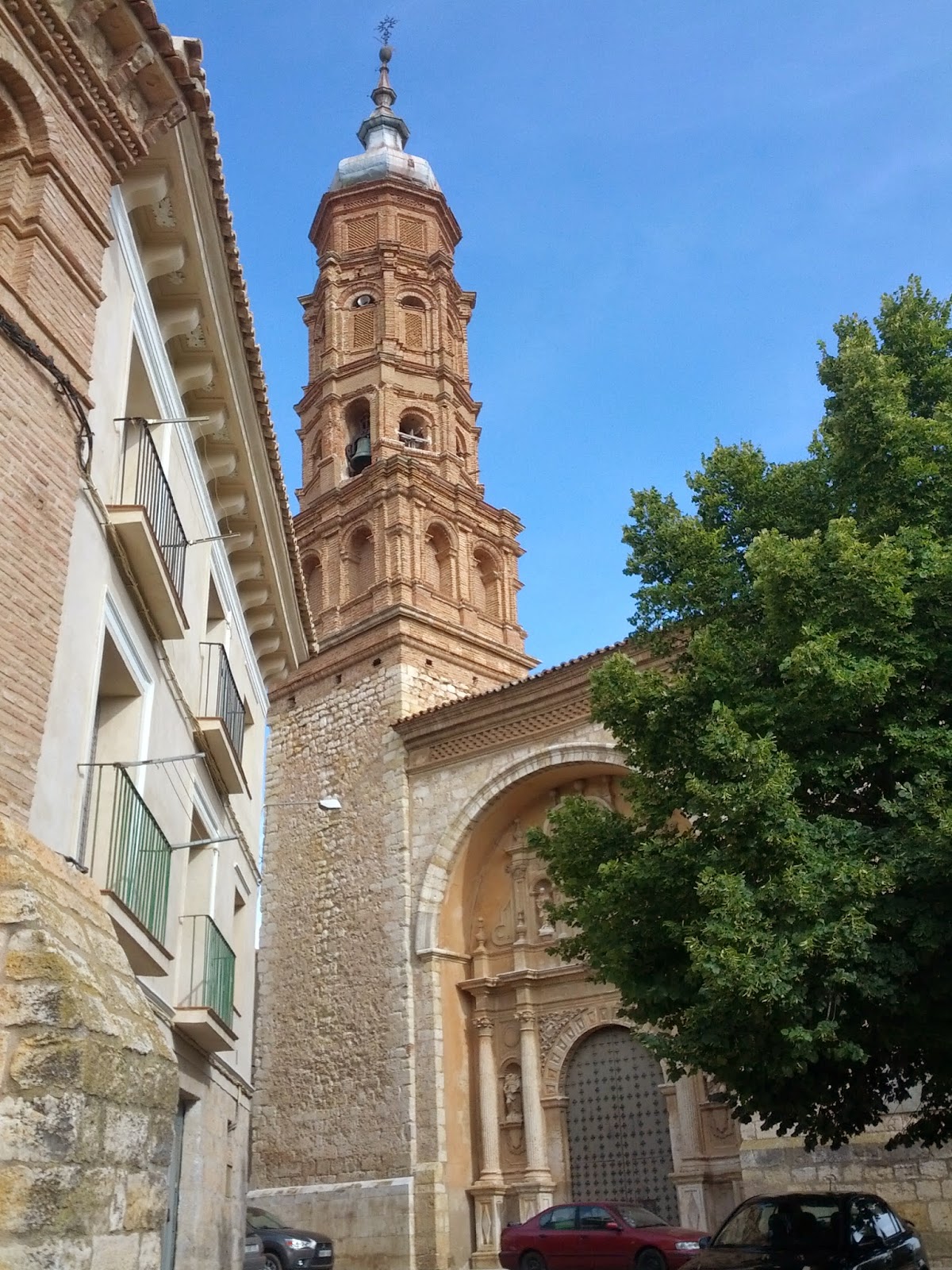
I stopped at a couple of other spots that caught my fancy. First a tower on a hill guarding the town in the valley below. For some reason all the towers in Aragon seem to be locked. I never succeeded in getting up any of them. Then a very distinct, Aragonese style, cathedral appeared over the top of the buildings of a small town. It seemed so grand for a town of that size so I went and had a look at the statues feeling the niches on its facade. 

From here I saw a fortress on the hill. I found a street leading towards it and took it. At the top it turned to dirt. I drove a little further then parked, exploring the fortress and towers on foot. For a small, unknown village this place seemed to have a lot to offer. I got some curious stares from the locals, perhaps because they aren't used to tourists in Czech cars driving into the upper reaches of their town.

When I returned to the car and attempted to drive off it was stuck. I cursed. One of the wheels was repeatedly spinning, almost in air, on a sleek rock. I had somehow managed to park it in a place where it couldn't get traction. After fifteen odd goes I got it free before driving very carefully back down to meet the sealed road.

I got within 4km of my final destination before seeing a river which forced me to stop. After several days in the intense heat it was well overdue. I laid down on the smooth stones of its shallow, fast moving water, soaking my whole body. Its hard to describe how good it felt after the time I'd spent in the desert like landscape of that region. I spent two odd hours there, the sun threatening to set on me before I had time to explore the place I'd come here for.

Sunday, 17 August 2014

Killing Time in one of the World's Smallest Nations


Andorra is sometimes know as the “Principality of the Valleys of Andorra”. This name seems more than apt. Its capital, Andorra La Vella, merged with the allegedly separate city of Escaldes, and every other town in the country seem to sit at the bottom of valleys, consuming what little flat land there is. When I've mentioned Andorra to Spaniards the first thing that seems to come to mind is “oh, that little place where our politicians take their money”.
The best of inner city parking
The Andorran borders actually have customs houses, a rarity in the EU. I suppose this is to try and regulate the flow of tax free goods going back into Spain. In the supermarket it's not uncommon to see trolleys of 20-30 bottles of alcohol being loaded into Spanish cars. 
 
Despite having border controls no regulation really seems to happen. You don't have to stop, only slow down to 20km an hour. And very rarely does anyone get pulled over. One day however this border control cost me an our of my time, creating a ten kilometre traffic jam lasting well into Spanish territory.

Once in Andorra I headed to an Intersport I saw signs for, hoping they could help me fix my tent pole. I'd been sleeping in a broken, droopy tent for two nights. The people at Intersport couldn't help but a woman spent well over an hour slowing down her speech for me and choosing her words carefully so we could speak in Spanish. I was shocked at the end to realise her English was really good. We talked about hiking in Andorra, Via ferratas and various other things. After they couldn't help it was clear I wouldn't buy anything but yet again the world showed me its still full of people with big hearts that will go out of their way for foreigners.
My first day in Andorra this was a constant companion...
Now back out on the street I was hit with twelve degrees and pouring rain. The weather is uniquely fickle in Andorra. I headed to the autoshop down the road and explained to them that one of the windscreen wipers had stopped working. A lot of hand gestures were used to bridge gaps in my vocabulary.

One and a half hours later I left with a zip tie fix and twenty euros less in my pocket. And it broke again within three actions, batting torrents of water from the windscreen. Dammit! It would have to wait for tomorrow.

Better weather!
I found some camping and slept off the atrocious weather. I was pleasantly surprised by the weather the next day. I was greeted by a gentle, cool breeze and blue skies with wispy feathers of white.

I went to the shop the woman at Intersport recommended, an old fashioned outdoors store and told them what the problem was. They sent me to their other store. They have two. One that handles the general public and another selling technical gear. The guys at the second store spent 40mins fixing my pole, entirely for free. I bought some chalk as a courtesy. I needed some and I wanted to thank them in some way. Afterwards I headed up a Via Ferrata, right in the middle of the city. 
The first few stretches were super easy and I didn't even clip in. The things got more serious. A vertical wall loomed in front of me with an overhang 20m above the ledge I was standing on. I clipped in and started pulling myself up from rung to rung. Things got exposed real fast. Soon it felt like it was a direct 100m drop onto the houses of the city below.
After a few steep walls it shifted onto an arete with a few slab crossings and a lot of not so steep climbing on knife edges. It was spectacular. An hour and a half after leaving the ground, taking a lot of breaks for photos and to enjoy the sheer transition to the city in the valley below, I arrived at an hermita. There were no signs saying which way was down so I headed down the only track I could find. It went in the complete wrong direction.

After a lot of worry and considerable time I discovered this was because it dropped down behind into a valley, crossed into a small saddle, then dropped back to the car. I was very happy to say the least.

At about one I went back to the autoshop. The owner gave up his siesta time, when the shop closes, to find me a spare part in the city's scrap yards. All up the car stayed at the shop for four hours before it was fixed where I had almost nothing to do. I aimlessly wandered through the city, read at the car. Thankfully at the end of it the windscreen wipers were in perfect working order after a long time of not but very little rain.
Downtown Andorra La Vella, technically Escaldes I think
The next day I set out to climb a Via Ferrata, recommended by the guys at the old fashioned shop, at 7pm. They told me It takes 40mins up and 20mins down. This isn't the case. I was moving quite fast and after their stated time I was still craning me neck, looking at numerous walls and slabs disappearing into the sky. After an hour and a quarter or so the cables finally ended.

And then the fun started. I was climbing a steep sided ridge, again in the opposite direction to my car. Darkness was closing in and doubt about whether I'd gone the right was was growing. After 30mins of walking very fast I reached a saddle with a junction sign. I recognised none of the names on it. I took the one that headed down. In another 20mins I hit a road and felt the weight recede from my shoulders. 
 
Then I realised, again, I had no idea where I was. I was looking at a picnic ground in a picturesque bowl on the side of a hill that I had never seen in my life. I walked left, only to be stopped by a private property sign. When I got back to where I emerged a man on a motorbike turned up. I explained to him in Spanish that I had just climbed the Via Ferrata and didn't know where I was.

He enlightened me. My car was twelve kilometres away. He gestured to the back of his bike. Hop on.
A church on the descent, taken the following day
He took me back to my car at a very low speed, owing to the various hairpins, the fact I had no helmet and that he wanted to talk the whole way down. He moved from Germany to Andorra six years ago to work for Nissan and had supposedly been a boy scout for thirty years, the reason why he always helps people in trouble like myself.

I thanked him sincerely and just sat for a moment. It was now dark. I couldn't believe I'd gotten off quite that easily. Then I drove up to the picnic ground and camped.
The next morning I drove up to 2500m, looking for a different Via Ferrata, but to no avail. The temperature of two degrees Celsius didn't entice me out of the car for a hike either. I spent the day in Andorra La Vella, in a park, then on WiFi for a couple of hours. I plotted the rather lengthy route that lay ahead and simply talked to a few people back home. Then it was time to go. Back at the car I found a fine for 60 Euros, the cost of not being able to find a park and parking on the footpath for four hours. Maybe I would have been saved if I used the hazard lights. Oh well, paying fines when the car isn't registered in you name is an optional practice anyway. 

I needed to be in a completely different region of the country within a couple of days. The first section of road was the familiar stretch to Seu but past there everything was new. After several gentle valleys the road took the course of a number of gouges in the mountains with sheer rock walls, sometimes with intermittent lakes before entering the next. Then suddenly I was out. The land consisted of rolling hills, then it was dead flat.

En España, Finalmente

A city we passed through whose name escapes me, frantically en route to Spain
A small, inconspicuous town, partly in Pyrénées-Orientales, a Catalan speaking region of France, and partly in Spanish Catalonia has a small sign marking the border the two nations. As we crossed over most of the signs turned to Catalan from French, not French to Spanish. The Catalan language has a much better political standing in Spain than France. Despite appreciating linguistic diversity this was somewhat of a disappointment to me in all honesty. I was looking forward to being able to read the road signs, the posters, all the small things that feel exciting when you're learning a particular language. But this would have to wait.

 I was struggling with hunger as we crossed into Spain. Shortly after the border we pulled into a bakery and I ordered some cold pizza topped with tuna and tomato in Spanish. It felt great to finally be able to use the language. Although Catalan is the traditional language of the region and is still spoken by some ten million odd people everyone speaks Spanish. Except for in a handful of isolated, traditional villages where elderly people solely speak Catalan. In one village I was surprised to be great by literally every person I met in Catalan, not Spanish.

We descended the Pyrenees by way of a gorge and before long were in La Seu D'Urgell, an important regional centre and home to a slalom course built for the Barcelona Olympics. We quickly found the course, following a series of posters and kayaks in the middle of round-a-bouts. We spent most of the day here, lying on the grass, using their WiFi and for Dan, getting familiarised with the course and finding the Australian team.

I walked to town and bought a copy of one of Spain's national papers, El Pais. The elderly woman inside was very kind and loved that I wanted to learn her language. I spent some forty minutes talking with her until I stepped back out into the heat.

That night team accommodation started for Dan and I spent my first night camping alone. I found perfect camping near an hermita, a word in Spanish that describes a small church in the countryside, often accessible solely by foot. I hiked up here the next morning and watched the crimson light enter the valley, bringing day to the cut-off villages in its depths. 
The next few days were spent in and out of Spain and the small, Pyrenees nation of Andorra, a very mountainous little piece of land. 
 

Roaming Provence

We drove on towards the city of Orange, a slow journey through agricultural land on toll-free roads. As we entered the city the sky was looking moist and ominous. We parked right outside the city's iconic Roman theatre and hike up onto the hill that the city surrounds. After a lot of playing around we found some tracks that lead through some ruins to a ledge overlooking the theatre.
 The theatre costs fifteen euros or so to get into. I couldn't justify spending that much for what I perceived to be little gain. I think doing it this way we actually gained more, seeing a part of the city tourists usually don't get to see and seeing it from higher up. The steps of the ampitheatre, stretched out below, with the modern city extending behind looked truly spectacular from here.

As we drove towards the Pont du Gard the skies open. Day's worth of built up moisture bucketed down, forcing us to drive slow. We pulled over at one of the many road side pizza places. To our surprise, despite appearing to be fast food, this place had restaurant like service. The table was set for us and we were given bread and a karaff of water. Many western European countries seem to charge the same prices at both mid-level restaurants and fast food places. Fast food seems very expensive but many restaurants seem much cheaper than home. It's definitely unusual.

The broken chute that once guided water onto the aqueduct
The Pont du Gard costs twenty or so Euros to see. If you go to the tourist entrance, park in their carpark and walk down their invalid friendly road to the river. Its obvious to say we didn't. We parked in the forest a kilometre back and hiked through the hills for forty minutes, seeing various locals along the way, finding our way as we went. 

In time we began following the chute that deposits water onto the Pont du Gard itself. We knew we were going in the right direction. Then all of a sudden we saw it. It looks so much bigger and impressive in real life than it does in the tourist photos of it plastered all over southern France. I stopped for a few minutes, just taking in how mystical it looked, the sun burning off the moisture soaking the hills after the storm, creating an eerie yellow mist.
In another ten minutes we were at the top of the aqueduct itself. We wandered through the channel where water once flowed, under the huge stone slabs that form a kind of stone roof as you get closer to the centre. It felt surreal in the light, watching the mist receding from the moody atmosphere in both directions down the river valley.
We wandered down to the bottom and simply sat on the grass by the river, admiring this great accomplishment of early irrigation. Despite being far from natural, maybe because of its age, the multi-tiered structure of arches somehow feels like it belongs. 

The next day we headed to Nice to see its Roman temple and theatre. After walking around the city for a while we settled down at a cafe by the temple where I did some writing and replied to a few messages from the outside world.
 We couldn't stay at the cafe, sheltered from the oppressive heat forever and soon enough we were back on the road, destined to push the remaining distance to La Seu D'Urgell in one go.